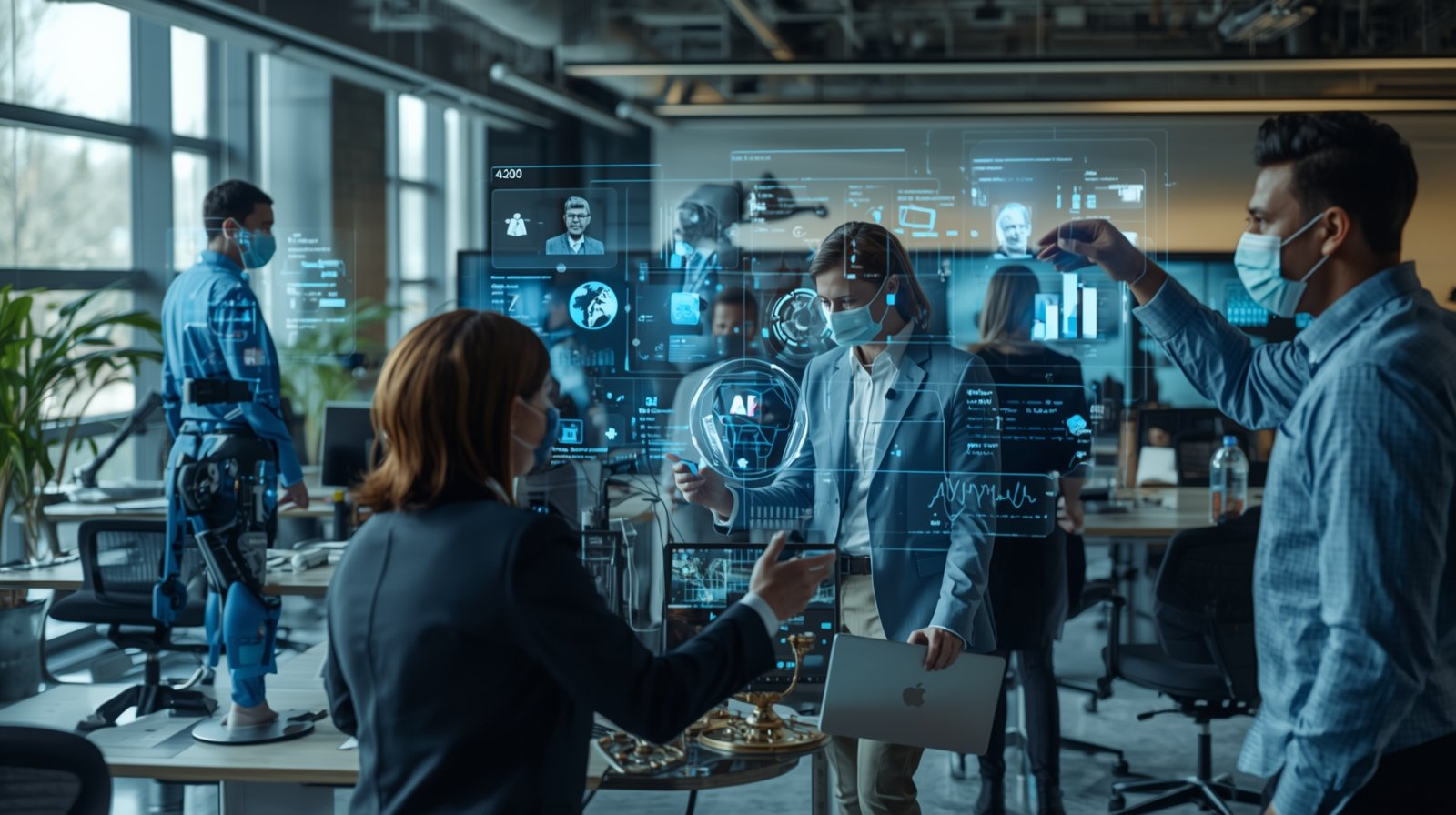
Artificial Intelligence (AI) has moved from innovation into routine business operations. In 2025, organizations across industries use AI to improve efficiency, enhance decision-making, and support new forms of work. The integration of AI does not simply replace jobs; it reshapes them. This article examines how AI is transforming employment, skill requirements, and the structure of work in the global economy.
1. The Evolution of Work and Technology
Throughout history, technological shifts have influenced labor. The industrial era replaced manual processes with machines. The digital age introduced computers and automation. Now, the AI era builds on data, algorithms, and automation to create a workforce where humans and machines collaborate.
In this stage, AI handles routine and data-heavy tasks, while human workers focus on strategy, creativity, and problem-solving. The evolution is not about elimination but adaptation.
2. What AI Means for the Workforce in 2025
AI systems perform functions that previously required human reasoning. These include pattern recognition, natural language processing, prediction, and decision support.
In 2025, companies use AI for:
- Customer service automation
- Predictive maintenance in manufacturing
- Fraud detection in finance
- Recruitment screening in human resources
- Data analysis and forecasting across industries
The result is a shift in what roles exist and what skills are required.
3. Industries Most Affected by AI
AI adoption varies across sectors, but its presence is nearly universal.
Manufacturing:
AI-powered robots and predictive maintenance systems increase productivity and reduce downtime. Workers now oversee automation systems instead of performing repetitive manual work.
Healthcare:
AI assists with diagnostics, patient monitoring, and administrative management. Healthcare professionals rely on AI to analyze data and improve treatment accuracy.
Finance:
Banks use AI to assess credit risk, detect fraud, and automate customer interactions. This changes roles in compliance, data analysis, and customer relations.
Education:
AI helps design personalized learning programs and automates administrative grading. Teachers focus on mentoring rather than routine assessments.
Retail and Logistics:
AI forecasts demand, manages inventory, and improves supply chain efficiency.
4. New Job Roles Emerging from AI
AI does not only automate work; it creates new positions that require oversight, design, and integration of intelligent systems.
New roles include:
- AI Systems Trainer: Helps algorithms learn from accurate data.
- Machine Learning Engineer: Designs and maintains learning systems.
- Data Analyst: Interprets AI-generated insights.
- AI Ethics Officer: Ensures systems operate responsibly.
- Human-AI Interaction Designer: Develops tools for efficient collaboration between humans and machines.
These positions show that human expertise remains essential in guiding technology.
5. Skills Required in the AI-Driven Workforce
The demand for technical knowledge grows, but soft skills remain important.
Core skills for the future workforce:
- Data literacy: Understanding how to read and interpret data outputs.
- Digital communication: Navigating remote and AI-assisted systems.
- Problem-solving: Identifying where AI can and cannot help.
- Ethical reasoning: Evaluating fairness, privacy, and bias in AI systems.
- Adaptability: Adjusting to new technologies and workflows.
Continuous learning is now a permanent part of career development.
6. AI and Automation: Complementary or Competitive?
A common concern is whether AI replaces human jobs. While automation reduces demand for certain roles, it complements others by improving productivity and accuracy.
Examples:
- AI handles repetitive administrative tasks, allowing professionals to focus on analysis and innovation.
- Automated chatbots manage simple customer queries, while humans handle complex issues.
- Data automation enables faster reporting, giving leaders time for strategic planning.
The most successful workplaces are those that integrate AI as a partner, not a competitor.
7. The Role of Human Creativity
AI can process data but cannot replicate human judgment or context. Creativity remains central to progress in design, research, marketing, and management.
Workers use AI to support the creative process—analyzing trends, generating ideas, and optimizing outcomes—but human input defines goals, ethics, and vision. The collaboration between AI and people creates innovation rather than replacement.
8. AI and Remote Work
Remote work expanded globally after 2020, and AI now supports it through automation, scheduling, and collaboration tools.
AI in remote work includes:
- Meeting transcription and summarization
- Automated task prioritization
- Productivity tracking
- Language translation for global teams
AI connects distributed teams, reduces time spent on coordination, and helps maintain work-life balance through optimized workflows.
9. Education and Workforce Training
Education systems are adapting to the new employment landscape. AI-related literacy is now part of school and professional training programs.
Focus areas include:
- Digital literacy and coding fundamentals
- Data interpretation and critical thinking
- Ethics in technology
- Continuous online learning
Training programs are shifting from one-time education to lifelong learning, ensuring workers can adapt to future roles.
10. AI in Recruitment and Human Resources
Recruitment is undergoing a major transformation through AI.
Applications include:
- Automated resume screening based on skill relevance
- Predictive models for job fit
- AI chatbots that handle initial applicant questions
- Sentiment analysis for employee feedback
While automation speeds up hiring, it also introduces discussions about fairness and transparency. Companies are combining AI tools with human oversight to ensure balanced outcomes.
11. Impact on Small Businesses and Entrepreneurs
AI tools once limited to large corporations are now accessible to small businesses.
Examples:
- AI-powered marketing platforms
- Automated bookkeeping systems
- Chat-based customer service
- Predictive sales forecasting
Entrepreneurs use AI to compete effectively with larger firms by saving time and optimizing resources.
12. Ethical and Regulatory Considerations
AI introduces new ethical and legal questions about data use, accountability, and decision-making transparency.
Common concerns include:
- Bias in hiring algorithms
- Data security and consent
- Fairness in automated decision-making
Governments and institutions are developing frameworks to ensure responsible use. Ethical understanding is now an important part of every professional role.
13. AI and the Global Economy
AI contributes to productivity growth across economies. However, the impact is uneven, with technology-intensive industries gaining more rapidly than manual sectors.
Developed economies benefit from high-tech infrastructure, while developing regions are focusing on skill training and digital inclusion. Collaboration between education, business, and government is essential for balanced growth.
14. Gender and Diversity in the AI Workforce
The AI industry has a growing emphasis on inclusion. Encouraging women and underrepresented groups to enter AI-related fields ensures diverse perspectives in algorithm design and system use.
Efforts include:
- Scholarships for women in technology
- Mentorship programs in data science
- Awareness campaigns promoting tech careers for all backgrounds
Diversity strengthens innovation by bringing broader human insight into AI development.
15. The Human-AI Collaboration Model
Workplaces increasingly rely on shared responsibility between humans and AI systems. Humans provide context, empathy, and ethics; AI delivers data-driven insights and speed.
Example collaboration:
- A doctor uses AI imaging tools but makes final diagnostic decisions.
- A journalist uses AI for research but writes and edits articles personally.
- A financial analyst uses predictive models but interprets them through experience.
This partnership defines modern productivity.
16. The Gig Economy and AI
AI also affects freelance and gig work by connecting professionals to projects more efficiently.
Examples:
- Platforms using AI to match freelancers with job opportunities
- Tools that analyze skill levels and project requirements
- Payment and workflow automation for independent workers
AI expands access to work and allows people to operate globally.
17. AI and Workplace Productivity
AI improves workflow by automating low-value tasks and offering decision support.
Examples:
- Automated report generation
- Predictive scheduling for meetings
- Data visualization for quick insights
These systems reduce manual repetition and increase output across industries.
18. The Need for Continuous Reskilling
As roles change, lifelong learning becomes essential. Employers invest in reskilling programs to help employees stay current with AI systems.
Reskilling areas include:
- Data management and analysis
- Machine learning basics
- Digital collaboration tools
- Cybersecurity awareness
Workers who learn continuously remain adaptable in an evolving economy.
19. The Psychological Side of AI in Work
Automation can bring uncertainty about job security, requiring careful transition management. Transparent communication from employers helps reduce anxiety and build confidence.
Supportive leadership and access to training help workers view AI as a tool rather than a threat. The goal is shared growth rather than displacement.
20. The Future Outlook: Building the AI-Ready Workforce
By 2030, most workplaces will include some form of AI integration. Human roles will shift toward interpretation, creativity, ethics, and emotional intelligence.
Predictions include:
- Hybrid human-AI teams as the standard model
- Universal data literacy becoming a core skill
- Growth of new industries built entirely around AI innovation
The future workforce will focus less on repetitive tasks and more on problem-solving and collaboration.